GOES Rebroadcast (GRB)
The GOES-R Series satellite’s scientific instruments sense the environment and distribute data to the
onboard computer for processing and distribution to the X-Band antenna for transmission to Earth as a
digital data stream. The ground system software at Wallops Command and Data Acquisition Station (WCDAS)
processes the Level 0 data and creates Level 1b products. For example, the measurements from the ABI are
converted to units of radiance and calibrated, navigated, and remapped to a fixed grid. The antenna at
WCDAS transmits the products to the GOES-R Series satellite for relay through the satellite’s GOES
Rebroadcast (GRB) transponder and L-Band antenna to GRB receive stations, including GRB receive stations
at the NOAA Satellite Operations Facility (NSOF).
The GRB provides the primary GOES-16 and GOES-17 relay of full resolution, calibrated, near-real-time
direct broadcast Level 1b data from each instrument and Level 2 data from the Geostationary Lightning
Mapper (GLM). The GRB is a significant increase in capability from the GOES VARiable (GVAR) service on
GOES 13, 14, and 15. The GRB contains the ABI, GLM, space environment, and solar data that drive the data
flow in the NOAA space and Earth environment research and operational frameworks.
To receive the GRB signal, a user installs a receive station consisting of an antenna, Low Noise
Amplifiers, RF/Intermediate Frequency (IF) downconverter, Digital Video Broadcasting-S2 (DVB-S2) capable
receiver and GRB-compatible demodulator, and processing software. The GRB link data rate is 31 Mbps and
between 1.5 TB and 2 TB of data are transmitted during a 24-hour period.
The GRB data stream includes the ABI Level 1b products. In Mode 4, or Continuous full disk mode, the ABI
produces a full disk image every 5 minutes. In Mode 3, or Flex Mode, the ABI produces a full disk every 15
minutes, a CONUS image (resolution 3000 km by 5000 km) every 5 minutes, and two mesoscale domains
(resolution 1000 km by 1000 km) every minute or one domain every 30 seconds if it is set to that scanning
rate. All 16 Bands are available. A new mode, Mode 6, is being tested and if approved by NESDIS and NWS
then it would provide a full disk image every 10 minutes, CONUS image every five minutes, and images from
both mesoscale domains every minute.
In addition to the NOAA NESDIS GRB receive stations at the WCDAS, NSOF, and CBU, about 70 other sites have
installed or plan to install GRB receive stations.
The GRB downlink signal from the satellite is at a center frequency of 1686.600 MHz and requires an
antenna gain-to-noise-temperature (G/T) of 15.2 dB/K for worst-case
locations. Modulation is either 8PSK with a symbol rate of 7.825768 Million symbols per second (Msps) with
a rate 2/3 Forward Error Correction coding or QPSK with a
symbol rate of 8.665938 Million symbols per second (Msps) with a rate 9/10 Forward Error Correction
coding. However, the GOES-R program designated QPSK the default
modulation mode in 2017. The nominal antenna size: 4.5-meter dish with a system noise temperature of 120
degrees Kelvin. Off-the-shelf DVB-S2 receivers are available to
receive the IF outputs from the antenna system for each polarization. The DVB-S2 receiver extracts and
outputs CCSDS Channel Access Data Units (CADUs) at a rate of 15.5
Megabits per second (Mbps) from each polarization channel. The dual circular polarization facilitates a
data rate of 31 Mbps. For more information go to
GRB Downlink
Specifications.
The Product Definition and Users’ Guide (PUG) Volume 4 describes the GRB product content and format and
documents the communications and application level protocols
used in the GRB. The PUG Volume 4 lists the products that are on the Left Hand Circular Polarized (LHCP)
channel and on the Right Hand Circular Polarized (RHCP). The
ABI Level 1b products on the LHCP channel are similar to the products that were available on legacy GOES
Variable (GVAR) DB service provided by GOES-NOP.For more
information go to PUG Volume
4.
GRB users can generate products with software purchased from a vendor, developed by the user, or
downloaded from the University of Wisconsin – Madison Space Science
and Engineering Center’s (SSEC) Cooperative Institute for Meteorological Satellite Studies (CIMSS).
SSEC/CIMSS developed the Community Satellite Processing Package for
Geostationary Data (CSPP Geo) software with funds provided by the GOES-R Program Office.
As of December 2020, NESDIS had accounted for 96 GRB receive stations at 68 sites. GRB is a broadcast so
registration is not required. NESDIS requests that users complete a survey on the DCS Administration and
Data Distribution System (DADDS) website and join the GRB User Group.
View GRB for more information.
The Rebroadcast (Grb) Downlink Specifications For Users, August 6, 2012, is available at:
https://www.goes-r.gov/users/docs/GRB_downlink.pdf.
GOES-R Series GRB Ground Antenna Sizes
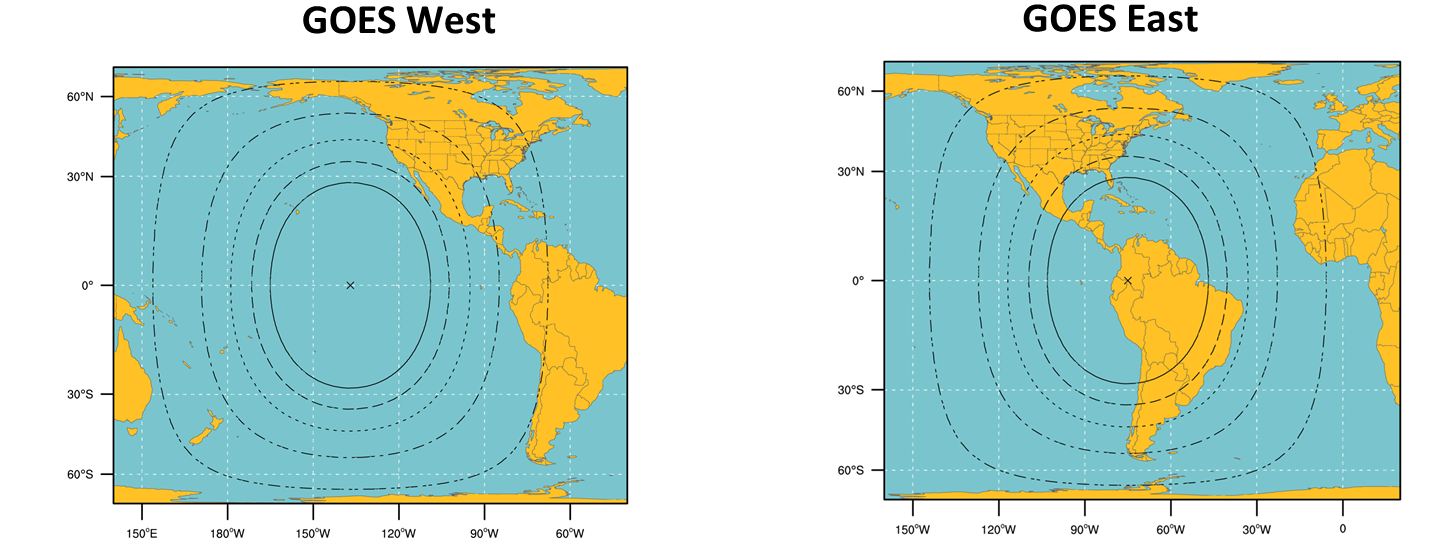
Notes
- Calculations are based on available data as of May 2011.
- Each antenna size is usable within the indicated contour.
- Included rain attenuation values are 1.3, 1.6, 2.0, 2.2, and 2.5 dB (for antenna sizes ranging
from 3.8 to 6 m).
- An operating margin of 2.5 dB was included in the calculations. However, users are cautioned
that this margin may be insufficient in parts of North America where strong interference from
cellular and mobile internet service providers exists. In such cases, additional antenna gain may
be required.
Antenna Diameters
- ─ -- ─ -- ─ -- 6.0 m
- ─ - ─ - ─ - ─ 5.0 m
- ---------------- 4.5 m
- ─ ─ ─ ─ ─ ─4.2 m
- ─────── 3.8 m
Also The George C. Marshall Space
Flight Center maintains a GOES Health Monitor
GRB Users
GRB users can join the NOAA-led GRB User Group which encourages
collaboration among users, facilitates information flow among NOAA
and users, and helps OSPO measure user readiness during the
transition from GVAR to GRB. All Direct Readout (DRO) Users can
complete the DRO Survey. The GRB User Group has over 160 members. To
join, contact Toby Hutchings at
toby.hutchings@noaa.gov.
GOES-R GRB Sites

Joint GRB and HRIT/EMWIN User Meetings
| 10 September 2024 |
24 October 2023 |
15 March 2023 |
|
|
|
|
Specifications
Reception of the GOES Rebroadcast (GRB) data is accomplished by means of a fixed dish antenna with a
dual left and right hand circular feed horn connected to two Low Noise Amplifiers. The Low Noise
Amplifiers outputs are connected to Radio Frequency/ Intermediate Frequency down-converters which are
connected to Digital Video Broadcasting-S2 (DVB-S2) capable receivers. The GRB downlink signal from
the satellite is at a center frequency of 1686.600 MHz and requires an Antenna
gain-to-noise-temperature (G/T) of 15.2 dB/K for worst-case locations. Modulation is either:
-
8PSK with a symbol rate of 7.825768 Million symbols per second (Msps) with a rate 2/3 Forward Error
Correction coding
-
QPSK with a symbol rate of 8.665938 Million symbols per second (Msps) with a rate 9/10 Forward Error
Correction coding
The GOES-16 default modulation mode is QPSK.
Nominal antenna size: 4.5 meter dish with a system noise temperature of 120 degrees K. The Link Budget is
available here. A dual circular polarization is used to accommodate the 31 Mbps data rate
Click here for the product allocation on Right Hand Circular Polarized (RHCP) and Left Hand Circular
Polarized (LHCP).
The GOES-R series GRB Downlink Specifications are available on the GOES-R Documents page.
View GRB Link Budget Document
(PDF)